
SEO Title: 3 Carry-On Luggage Myths You Still Believe (And the Truth)
SEO Description: Stop packing with bad advice. We bust three stubborn carry-on luggage myths and reveal what actually works for stress-free, airline-approved travel.
Focus Keyword: carry on luggage myths
Author Role: editor
Categories: Facts & Myths
Tags: myths, facts, truth
Let’s be honest: the world of travel advice is a swamp of outdated tips and “hacks” passed down like family heirlooms. For every useful packing tip, there are ten pieces of misinformation that can lead to a gate-check fee, a broken zipper, or a miserable trip. Why is this category so full of bad intel? It’s a mix of nostalgia (“My dad’s leather suitcase lasted 40 years!”), fear of airline rules, and a flood of social media content prioritizing ‘vibes’ over verified facts. We’re here to drain the swamp. Grab your boarding pass, and let’s bust some myths.
Myth #1: “Hard Shell Luggage is Always More Fragile Than Soft-Sided”
❌ The Myth: The old wisdom says a soft, fabric suitcase can absorb impacts and squish into tight spaces, while a hard shell is a brittle egg waiting to crack under the first rough baggage handler.
✅ The Truth: This might have been true in the era of cheap, brittle plastic shells. Modern materials have changed the game. High-quality hard shell luggage is now made from advanced composites like ABS combined with polycarbonate (PC). This blend creates a shell that is impact-resistant, lightweight, and often has excellent scratch resistance. It doesn’t just crack on impact; it’s designed to flex and bounce back. Meanwhile, a soft-sided bag offers zero protection against crushing, and a sharp object can easily pierce the fabric and damage your belongings. Which would you rather have protecting your laptop?
💡 What To Do Instead: Judge the material, not the category. Look for terms like “ABS+PC hard shell” or “polycarbonate blend.” These indicate a modern, durable construction. A good hard shell acts like a exoskeleton for your stuff. For soft-sided bags, prioritize high-denier ballistic nylon and robust corner protection. But for sheer crush and water resistance, a modern hard shell is often the tougher choice.
“I’ve gone through 2 bottles already. Definitely repurchasing.”
— u/glow_getter_97 on Reddit
Myth #2: “If It Fits in the Overhead Bin Sizer, You’re Guaranteed Approval”
❌ The Myth: The metal sizer at the gate is the final, infallible judge. If you can cram your bag in there, no airline employee can stop you from bringing it on board.
✅ The Truth: I used to believe Myth #2 myself until I watched a flight attendant stop someone with a perfectly “sized” bag because its overstuffed, bulging sides made it impossible to fit in a actual packed overhead bin. The sizer is a guideline, but flight crews have ultimate discretion based on how full the flight is and the bag’s real-world dimensions. A bag that’s the exact maximum dimensions but has external pockets crammed full or a handle that doesn’t fully retract can be denied. It’s about the bag’s functional size, not its theoretical one.
💡 What To Do Instead: Buy a bag that’s smaller</em than the maximum allowed dimensions for your most frequent airline. This gives you a buffer. Also, pay attention to the bag's profile. A sleek, rectangular design without protruding pockets or hardware is more likely to slide into a tight space than a bag with a bunch of external gizmos. The goal is to make your bag look compact and compliant, not like a puzzle you've solved under duress.
Myth #3: “More Wheels Just Means More Things to Break”
❌ The Myth: Two sturdy wheels are all you need. Those fancy four spinner wheels are a gimmick—flimsy, prone to snapping off, and useless on cobblestones or carpet.
✅ The Truth: This is the mindset of someone who hasn’t sprinted through a terminal in the last decade. Dual-wheel suitforces you to drag and tilt the bag, putting uneven strain on the wheels and your shoulder. Four 360-degree spinner wheels distribute weight evenly and roll effortlessly alongside you. The engineering has improved drastically; quality spinner wheels are now recessed into the shell for protection and use durable, sealed bearings for a smooth, silent roll. But wait — if two wheels were so much better, wouldn’t every new premium suitcase still use them?
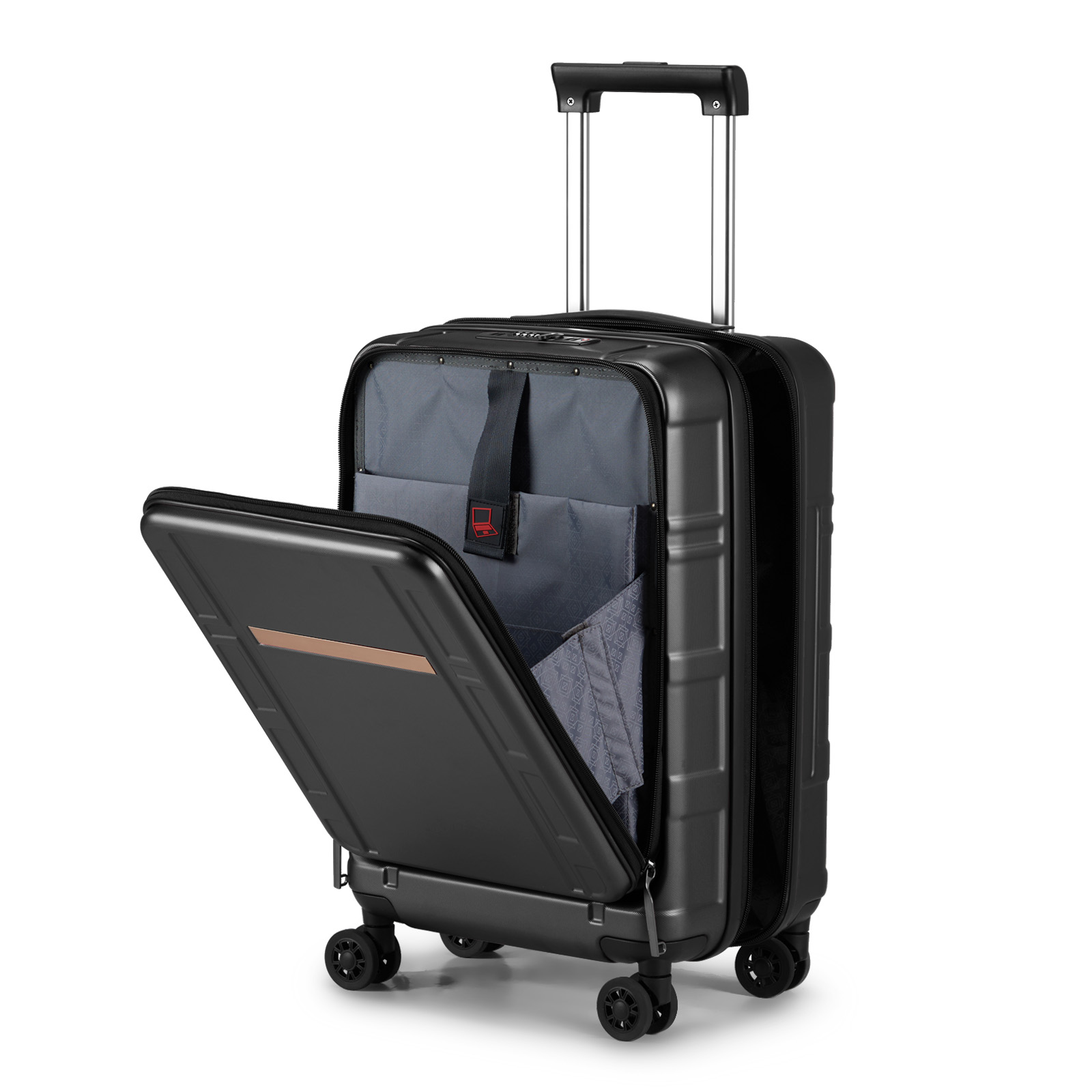
💡 What To Do Instead: Embrace the spin. Look for luggage with double spinner wheels—meaning two wheels on each corner. This provides greater stability and weight distribution than single spinners. Test the wheels in the store; they should spin freely and feel solid, not wobbly. A bag like the 20in Black Carry On with 360-degree silent spinner wheels is a perfect example of this done right. The wheels are designed for maneuverability, not as an afterthought, making navigation through crowded airports or narrow airplane aisles a one-handed task.
What Actually Works: Evidence-Based Packing for Modern Travel
Forget the folklore. Smart travel is about matching your gear to the reality of modern airports, airline policies, and your own sanity. Here’s what an industry expert would tell you to look for:
1. Prioritize Precise Dimensions & Clean Lines. Don’t play size-limbo. Choose a bag engineered to be airline-approved, like a 22″ x 14″ x 9″ carry-on. Its rigid hard shell maintains that shape even when full, so you never get hit with a surprise bulge at the gate.
2. Smart Features Beat Gimmicky Ones. A front-facing compartment for quick laptop access at security is a game-saver. A recessed TSA lock adds security without snagging. Telescopic handles with multiple height settings are crucial for comfort. These are the features that solve actual travel problems.
3. Build for the Worst-Case Scenario. Your bag will be bumped, dropped, and shoved. Protective corner bumpers, quality zippers, and a material that can handle a rain shower are non-negotiable. A bag constructed from an ABS+PC blend offers that resilient, worry-free shell.
In short, the ideal carry-on isn’t about the most pockets or the loudest color. It’s a reliable tool: a durable, correctly-sized hard shell with intelligent storage, superior wheels, and a handle that doesn’t fight you. It’s the difference between starting your trip stressed and starting it ready to go. Ditch the myths, pack the facts, and travel smarter.